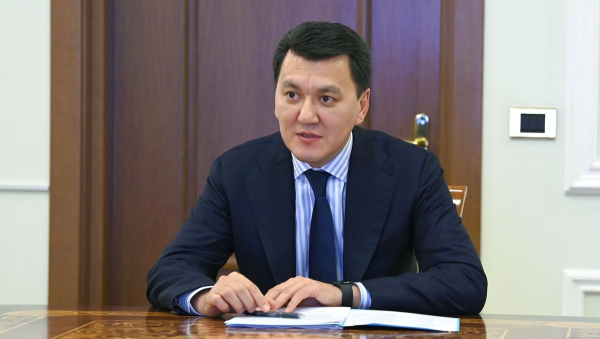
Yerlan Karin, Tokayev’s Counselor: “Kazakhstan Won’t Be a Parliamentary Republic”
The president will retain its power, despite a stronger role for Parliament
Осы мақаланың қазақша нұсқасын оқыңыз.
Читайте этот материал на русском.
As a new working group continues to develop a package of parliamentary reforms recently proposed by President Kassym-Jomart Tokayev in his Address to the Nation in September, state counselor Yerlan Karin spoke to a group of journalists at the end of October in Astana to explain the likely substance of the reforms, their significance, and the thinking behind them.
In the discussion, Karin, a top presidential advisor, explained that the transition to a unicameral legislature would grant the parliament expanded institutional powers while maintaining the existing presidential system. This would also mark the establishment of a new proportional election system nationally, while leaving the majoritarian system in place at the local level.
From his perspective, the changes form part of a larger package of reforms that have been introduced since Tokayev entered office in 2019. According to Karin, these changes were “not pre-packaged,” but not entirely “spontaneous” either.
December 1 update: The October 29 meeting with the press followed the first meeting of the working group for parliamentary reform. To date, this remains the only formal meeting. Meanwhile, last week, Tokayev said that the unicameral parliament will consist of fewer deputies than the current two-chamber number. Tokayev also added that the long-standing “presidential quota” of deputies that were not elected, but nominated, will be eliminated. “All deputies will be elected directly,” Tokayev said at a forum on November 28.
Tamara Vaal, Vlast: At the working group’s first meeting, it was said that more than 40 constitutional amendments could be expected as part of the parliamentary reforms. Is there a rough idea yet of what the key amendments will look like?
People on social media are asking the same question: why are there so many [amendments]? After all, it’s practically equivalent to rewriting the Constitution. There are 40 of them because Parliament is one of the core pillars of any political system.
Right now, we’re only talking about the articles that concern the work of parliament itself. The president has already said that, unfortunately, some experts interpret the upcoming reform too simplistically, as if it were merely about abolishing the Senate. But the proposed parliamentary reform is not a mechanical process. It’s about building a meaningful, independent institution: A unicameral parliament.
There’s also a common opinion circulating online: Everyone supports the move to a unicameral parliament, so what’s there to discuss? Why create a working group? And why spend money on holding a referendum at all? But again, it’s not that simple. In fact, we have a lot of issues to discuss.
Ayan Oribayev, Tizgin.kz: When the majoritarian electoral system was introduced for the March 2023 parliamentary elections, it was seen as a positive reform: candidates were to be elected to the parliament for whom people had voted. Under the proposed reforms, it will no longer be possible to run for the next parliament in single-mandate constituencies. Is this final or still under discussion?
In the event of a transition to a unicameral parliament, its structure should be based on a proportional system. We have carefully considered this issue, and most experts support this proposal. I have held meetings with the leaders of political parties and parliamentary factions, and they also support this idea.
It is important to note that we are not abandoning the majority system entirely. It will be retained at the local level. Today, 50% of regional assembly deputies are elected in single-member constituencies, and the other 50% are elected through a proportional system. At the same time, district and city council deputies are elected entirely through single-member constituencies. Why’s that? So they work with the local population and solve specific problems on the ground. Voters should be able to directly elect their representative and, through them, resolve issues concerning their community.
The majoritarian system cannot be considered perfect; it has its downsides as well. We saw that in 2023. One example is tribalism; we’ve spoken openly about it. In several districts, election outcomes were influenced not by a candidate’s program, charisma, or strengths, but by their lineage or family ties. Have women or people with disabilities won single-mandate constituencies or been given equal opportunity to participate? On the contrary, it is thanks to the proportional electoral system and party list quotas that our parliament today includes citizens with disabilities as well as young professionals.

Armangul Tokmurat, Qazaqstan TV: Kazakhstan has implemented a whole range of political reforms recently. In 2023 alone, a referendum was held, and for the first time, representatives of six parties entered parliament. Now the president has put forward an initiative to create a unicameral parliament. Why do reforms take such a long time? Why not implement them more quickly?
The transition to a unicameral parliament brings with it a whole range of questions, for example: How many deputies should there be? Should that number increase or decrease? Our experts are currently studying the experience of other countries; in some, the number of seats depends on the population size; in others, on the number of voters. There are also countries where the size of parliament is fixed and does not change even if the population grows. There are different approaches, and we are analyzing them all in order to determine the most suitable model.
After determining the number of deputies, it will be necessary to determine the number of parliamentary committees. Will there still be seven committees, or will there be new ones? Such questions cannot be decided by drawing lots; we can’t simply say, “let’s have 120 deputies,” or “let’s have 90.”
All proposals will be submitted for discussion by the working group. At present, the working group includes the leaders of all six parliamentary party factions. Their positions differ.
“Kazakhstan remains a presidential republic.”
Yerbolat Mukhamedzhan, Jibek Joly TV: Can these reforms be considered a continuation of the previous reforms of 2022-2023? Were these already planned?
Since 2019, we have put forward certain policy initiatives every year and implemented them consistently. Step by step, we have consolidated each element, combining them into a single system. If the reforms were not coordinated with each other, it would be the most dangerous path to take. Therefore, of course, all political steps taken today are logically and substantively interrelated.
However, we approach each reform not “for the sake of reform,” but out of necessity, above all, functional necessity. It can’t be said that everything was planned in precise detail from the start. But neither can we say that it happened spontaneously.
Tamara Vaal, Vlast: You said that the powers of Parliament will be significantly strengthened. But we won’t end up with a parliamentary republic?
No. The prospective parliamentary reforms will certainly strengthen the powers and authority of parliament. But it is no coincidence that the president often mentions that Kazakhstan remains a presidential republic.
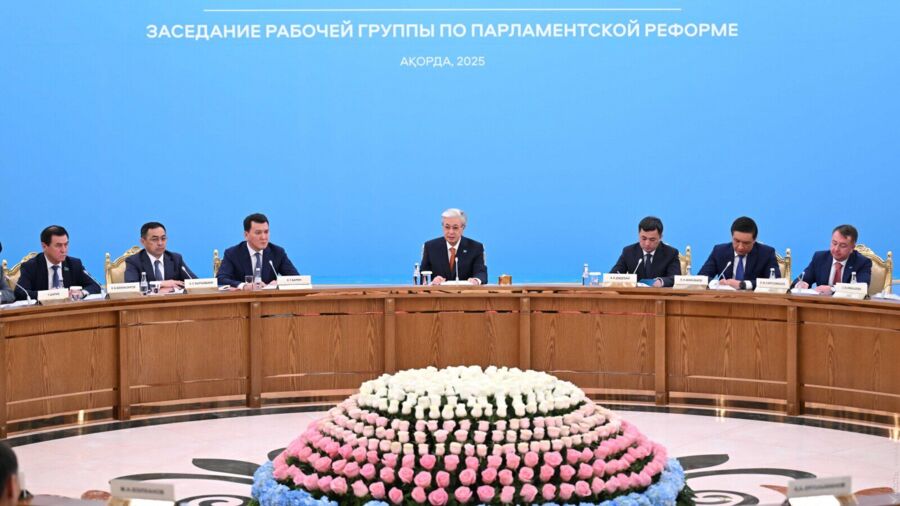
Tamara Vaal, Vlast: And will the presidents — former, current, and future — have the right to apply for the position of Speaker of Parliament as a matter of priority or as a whole? Can such issues be discussed yet?
I’ll say it like the youths do: I can’t spoil it. We have several more seasons of parliamentary reform ahead of us.
Once we have decided on all the issues, we will still have a public debate in the form of a referendum. And then, in accordance with the new provisions of the Constitution, we will have to amend existing laws. The discussions will also spill over into the parliament itself. So it is still too early to talk about any specific provisions or issues. The working group has only just begun its work.
Tamara Vaal, Vlast: When is the next meeting of the working group and will journalists be able to access the meetings?
We have agreed that we will give the members of the working group a month to prepare their personal proposals. They must send us carefully thought-out proposals by November 15. After that, we will need at least another week or two to summarize all this, put it into blocks. Therefore, the second meeting will be held in late November or early December, as we are currently planning.
At the end of the interview, Karin noted that the working group’s meetings would be held without media presence. However, he promised to meet with journalists after each one to report on the substance of the discussions and the decisions made.
An edited version of this article, originally published on October 29, was translated by Oliver Fisk.
Власть — это независимое медиа в Казахстане.
Поддержите журналистику, которой доверяют.
Мы верим, что справедливое общество невозможно построить без независимой журналистики и достоверной информации. Наша редакция работает над тем чтобы правда была доступна для наших читателей на фоне большой волны фейков, манипуляций и пропаганды. Поддержите Власть.
Поддержать Власть




Новости



Durys Info – Правильные новости твоей страны
Новости 24. Новости регионов. Россия - Азия. Последние события, конфликты и происшествия, обновления новостей онлайн на Durys Info каждый день.